
Blog
December 30, 2025•9 min read 

The Art of Selective Caring

Why the book everyone misunderstands might be the most important one you read
Aryan Techie
The Art of Selective Caring
I was tired all the time without moving forward. Not physically exhausted — mentally drained. The kind of tired that comes from spending energy on opinions, explanations, and approval while the things that actually mattered got whatever scraps were left over. I'd explain my choices to people who didn't ask. Defend my timeline to people who wouldn't remember. Over-justify my decisions to people whose opinions changed nothing. And at the end of each day, I'd wonder why I had no energy left for the work that actually mattered. That's when it clicked: I wasn't caring because it was important. I was caring because I was afraid. Recently, I read "The Subtle Art of Not Giving a F*ck" by Mark Manson, and one concept hit me so hard I had to put the book down.
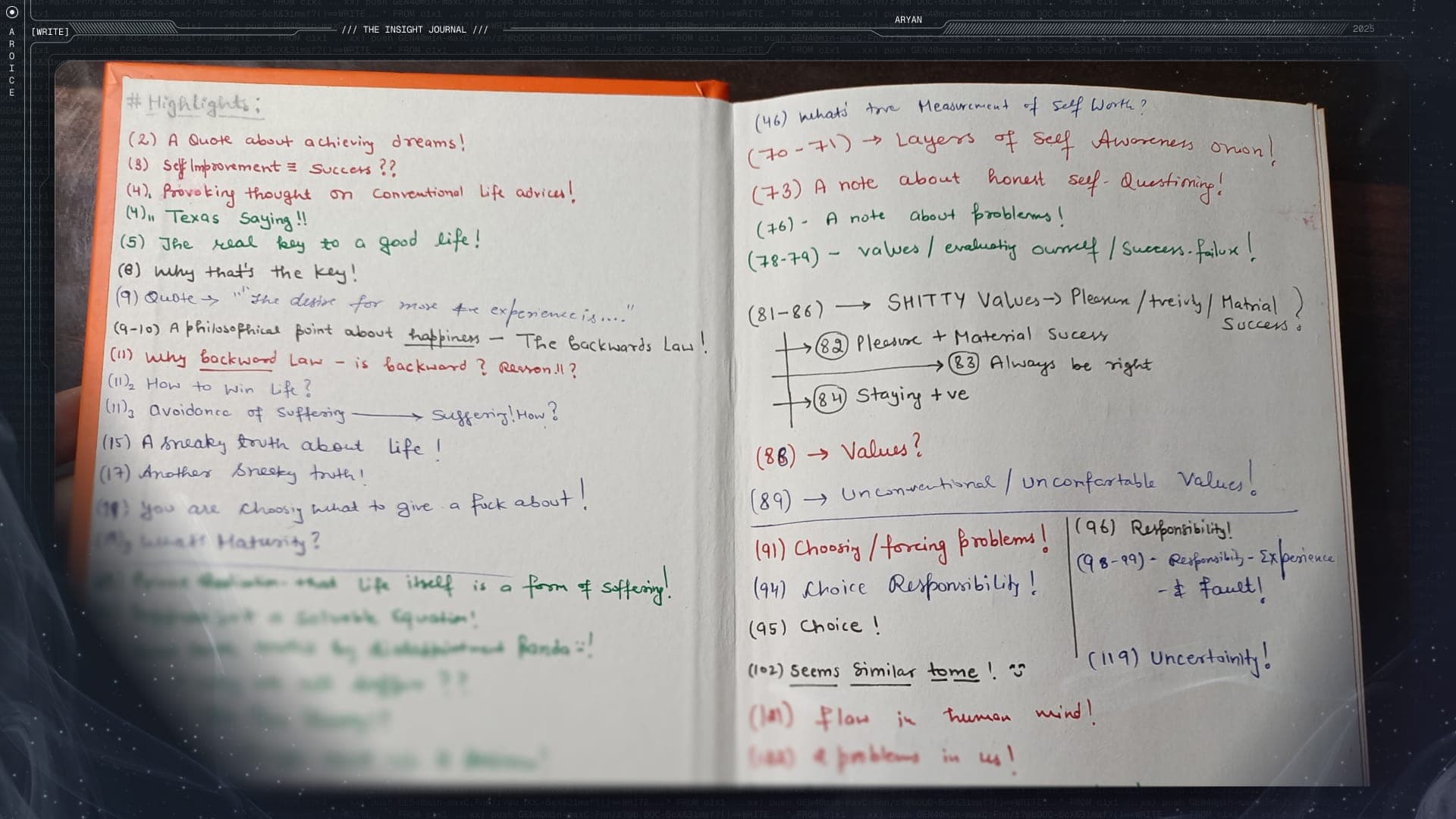
Bookmarks - The Subtle Art of not giving a f - manson - aryantechie
Most people think this book is about apathy. About saying "fuck it" to everything and becoming some detached, nihilistic asshole who doesn't care about anything. That's not what it's about. The book isn't teaching you to care about nothing. It's teaching you to care deliberately — to choose what deserves your emotional energy and let everything else burn out on its own. But here's what nobody tells you: this is way harder than it sounds. Because the things we give too many fucks about? They're usually tied to fear, not importance. Of all the concepts in the book, this one hit me hardest:
“The more something threatens your identity, the more you will avoid it.”
—Mark Manson
Read that again. It's not that we're lazy. It's not that we don't know what to do. It's that the thing we need to do threatens who we think we are, so we avoid it to protect our self-image. Examples:
  • I think I'm a "smart person" → I avoid situations where I might look stupid → I never learn anything new
  • I think I'm a "good person" → I avoid difficult conversations where I might be wrong → I never grow
  • I think I'm "creative" → I avoid shipping work that might be judged → I never create anything
The avoidance isn't protecting you. It's controlling you. And the only way out is to do the thing that threatens your identity anyway — to prove to yourself that your worth isn't tied to being perfect, always right, or universally understood. After reading this, I tried something different. I stopped giving a fuck about being perfectly understood by everyone. Earlier, I'd over-explain my choices — my work, my pace, why I wasn't doing what people thought I should. It drained me and changed nothing. So I made a decision that felt right to me, explained it once clearly, and then stopped defending it. Let people misunderstand. Let them assume. I kept moving. What happened?
  • Some people drifted away (fine)
  • Some opinions got louder (irrelevant)
  • My mental space got quieter (priceless)
That was "not giving a fuck" in practice — not apathy, but choosing what's worth my emotional energy and letting the rest burn out on its own. The difference was immediate. I had energy again. Not because I was doing less, but because I stopped hemorrhaging attention on things that didn't matter. But here's where I disagree with Manson: the book sometimes makes it sound like you can just decide to stop caring. In theory, it's clean. In practice, it's messy. You don't just wake up and stop giving a fuck about:
  • People you love
  • Past trauma
  • Deep insecurities
  • Validation you've been conditioned to seek for years
Trying to "not care" too hard often backfires — you just end up emotionally suppressing, not transcending. That's not strength, that's avoidance wearing confidence clothes. What does work is the deeper version the book hints at but doesn't always emphasize enough:
“You don't stop giving a fuck. You get better at choosing what deserves one — slowly, painfully, with repetition.”
So yeah, the philosophy is solid. The execution is oversimplified. Real life isn't "stop caring." It's "care deliberately, and accept the cost." If I could extract one concept from this book — one idea that if people actually lived it, would change their entire life — it would be this:
“Not your fault, but your responsibility.”
Your feelings, reactions, patterns, misery, growth — none of it magically changes when circumstances change. It changes when you stop outsourcing responsibility to:
  • Other people
  • Your past
  • Bad luck
  • "That's just how I am"
This doesn't mean self-blame. It means power. The moment you fully accept: "This is my life. I may not have chosen the problem, but I choose the response" — you stop waiting. You stop waiting to be:
  • Rescued
  • Understood
  • Validated
  • Saved
No motivation hacks. No spiritual bypassing. Just ownership. That's the one idea that actually changes lives — quietly, brutally, permanently. There's another concept in the book that explains why most self-help fails:
“The pursuit of positive experience is itself a negative experience. The acceptance of negative experience is itself a positive experience.”
—Mark Manson
Translation: The more you desperately chase happiness, the more miserable you become. The more you accept that life is hard and that's okay, the more content you become. This is why:
  • The more you desperately want to be rich, the more poor and unworthy you feel
  • The more you desperately want to be loved, the lonelier you become
  • The more you desperately want to feel confident, the more insecure you get
The wanting reinforces the lack. But when you accept: "Yeah, this is hard. Yeah, I'm struggling. That's fine, I'll keep going anyway" — something shifts. You stop needing perfect conditions. You stop waiting to feel ready. You just do the thing, uncomfortable or not. One of the most controversial ideas in the book is: "You are not special." People hate this. It sounds harsh, nihilistic, depressing. But here's what it actually means: You're not exempt. Not exempt from:
  • Pain
  • Effort
  • Failure
  • Responsibility
Most of our suffering comes from secretly believing we're the exception — that life shouldn't be this hard for me. That I deserve easier circumstances. That I'm owed something. When that illusion breaks, something strange happens: relief. Once you accept you're not special:
  • You stop demanding the world bend for you
  • You stop personalizing everything
  • You stop waiting for perfect conditions
And that is what frees you to become "special" in the only way that matters — through action, not entitlement. So yeah, everyone is ordinary. What makes you different is what you choose to do with that ordinariness. Here's what "not giving a fuck" looks like in practice: It's not:
  • Being an asshole
  • Ignoring consequences
  • Never caring about anything
  • Emotional numbness
It is:
  • Caring deeply about a few things
  • Letting go of the rest
  • Accepting discomfort as part of the process
  • Choosing your suffering
Because here's what Manson makes clear: You will suffer either way.
“The only question is: Do you want to suffer for things that matter, or suffer from avoiding them?”
Do you want the pain of discipline, or the pain of regret?
The discomfort of growth, or the comfort of stagnation?
The risk of trying, or the safety of "what if"?
Avoidance is easy. Responsibility is freedom. The hardest part of living this philosophy isn't the initial decision. It's the maintenance. Because society, your family, your friends — they're all still running on the old operating system. They expect you to care about the things they care about. They expect you to explain yourself. They expect you to seek their approval. And when you stop, it makes them uncomfortable. Your "not giving a fuck" forces them to confront their own anxious caring. Some will respect it. Some will resent it. Some will test it to see if you really mean it. This is where most people crack — when the social pressure builds. When people say you've changed. When they guilt you back into old patterns. But here's what I learned: The people who truly matter will adapt. The ones who don't... prove the point. If you take one thing from this, let it be this:
“You have a finite number of fucks to give. Where you're giving them right now determines the quality of your life.”
Ask yourself:
  • What am I avoiding because it threatens my identity?
  • What do I care about only because I'm afraid not to?
  • What would I do if nobody was watching?
  • What suffering am I choosing — conscious growth or unconscious stagnation?
You don't need to read the book to start (though you should — it's good). You just need to notice:
  • Where is your energy going?
  • Is it worth it?
  • What would happen if you stopped?
Try it. Pick one thing you give too many fucks about. Something that drains you without adding value. Something you do for fear, not love. And just... stop. Don't announce it. Don't explain it. Don't justify it.
Just quietly redirect that energy to something that actually matters to you.
See what happens. "The Subtle Art of Not Giving a F*ck" isn't about caring about nothing. It's about caring about the right things and accepting that you can't care about everything. It's about taking responsibility for your experience without needing to control everyone else's. It's about being comfortable with discomfort, because all growth lives there. It's about accepting you're not special — and finding freedom in that ordinariness. Most importantly, it's about choosing your suffering consciously instead of unconsciously. Because you will suffer either way. The question is: Will it be suffering that builds you, or suffering that breaks you? Will you avoid the hard thing and live with regret, or face it and live with growth? The choice has always been yours. You just have to stop giving a fuck about what happens when you make it.
I'm still figuring this out. Still catching myself caring about things that don't matter. Still practicing the art of deliberate caring. But I'm tired less often now. And the things I'm tired from? They're worth it. What's one thing you're giving too many fucks about right now? Not rhetorical. Actually ask yourself. The answer might change everything.

Share this post:

Subscribe to Aryan’s Newsletter

On The Insight Journal, I share ideas at the intersection of code, clarity, creativity, and systems.