
Blog
September 27, 2026•8 min read 

The Shape Your Pleasure Takes

Aryan Techie
The Shape Your Pleasure Takes
It was past midnight. I was tired, done for the day, phone charging on the nightstand like it's supposed to. Then I noticed my hand already reaching for it, thumb already unlocking, already opening Instagram, before any part of me had actually decided to. I wasn't bored. I wasn't even curious. My hand just knew the motion. That's the moment that sent me down a very specific rabbit hole: four books, two on happiness, two on addiction, read back to back, because I wanted to understand what's actually happening in that half-second between impulse and action. Turns out the two subjects aren't separate at all. They're the same mechanism pointed in opposite directions. There's an image that's been living in my head for weeks now: two graphs, same starting point. One is a funnel, every line collapsing toward a single point. The other is a fan, every line spreading further apart. The caption under them is the whole idea in one sentence. Addiction is a progressive narrowing of the things that bring you pleasure. Happiness is a progressive expansion of the things that bring you pleasure. That's it. That's the entire difference. Not "addiction bad, happiness good" as some vague moral instruction, but a literal structural description of what's happening to your life. An addicted brain keeps trading away sources of pleasure until only one is left. A happy life keeps adding more. Carl Erik Fisher, in The Urge, spends the whole book making the case that we've been telling this story wrong for centuries, treating addiction as either a moral failure or a purely biological disease, when it's neither on its own.
"The suffering of addiction is not an individual malady; it also comes from deep, ancestral wounds."
I don't think you need a diagnosable addiction for that line to land. You just need a phone. The scroll isn't a moral failure and it isn't a disease. It's a groove worn into your day by something that was built, on purpose, to be grooved. Here's the part that annoyed me the most in the best way: Nir Eyal wrote the actual manual for this. Hooked isn't a book about why people get addicted to their phones. It's a book teaching product people how to make that happen, on purpose, one trigger at a time. The mechanism is almost insultingly simple once you see it laid out. A trigger nudges you. You take a tiny, low-effort action. You get a reward, but not a predictable one, which is the part that actually hooks you, because your brain can't stop checking for the next unpredictable payout. Then you invest something back into it, a like, a follow, a streak, which makes the next trigger even easier to answer. Trigger, action, variable reward, investment. Repeat forever. None of that is an accident and none of it is really about you. It's about attention as a resource being extracted, cycle after cycle, and it works because it's built on the same reward circuitry that used to help us find food and stay alive. We just handed that circuitry to apps instead. This is the modern zombie addiction. Nobody plans to open Reddit for forty minutes. Nobody decides, consciously, to doomscroll before bed. You just surface forty minutes later wondering where the time went, hand still moving, brain only now catching up to what the hand already did. I kept thinking about that gap. The half-second where your hand is already moving and your brain hasn't checked in yet. That gap is where every trigger in Eyal's model does its work, because if you never notice the gap, you never get a say in what happens inside it. So I started building something to force a pause into that exact gap. It's a Chrome extension, MV3, codenamed WHY. Tagline: Know why you're here.
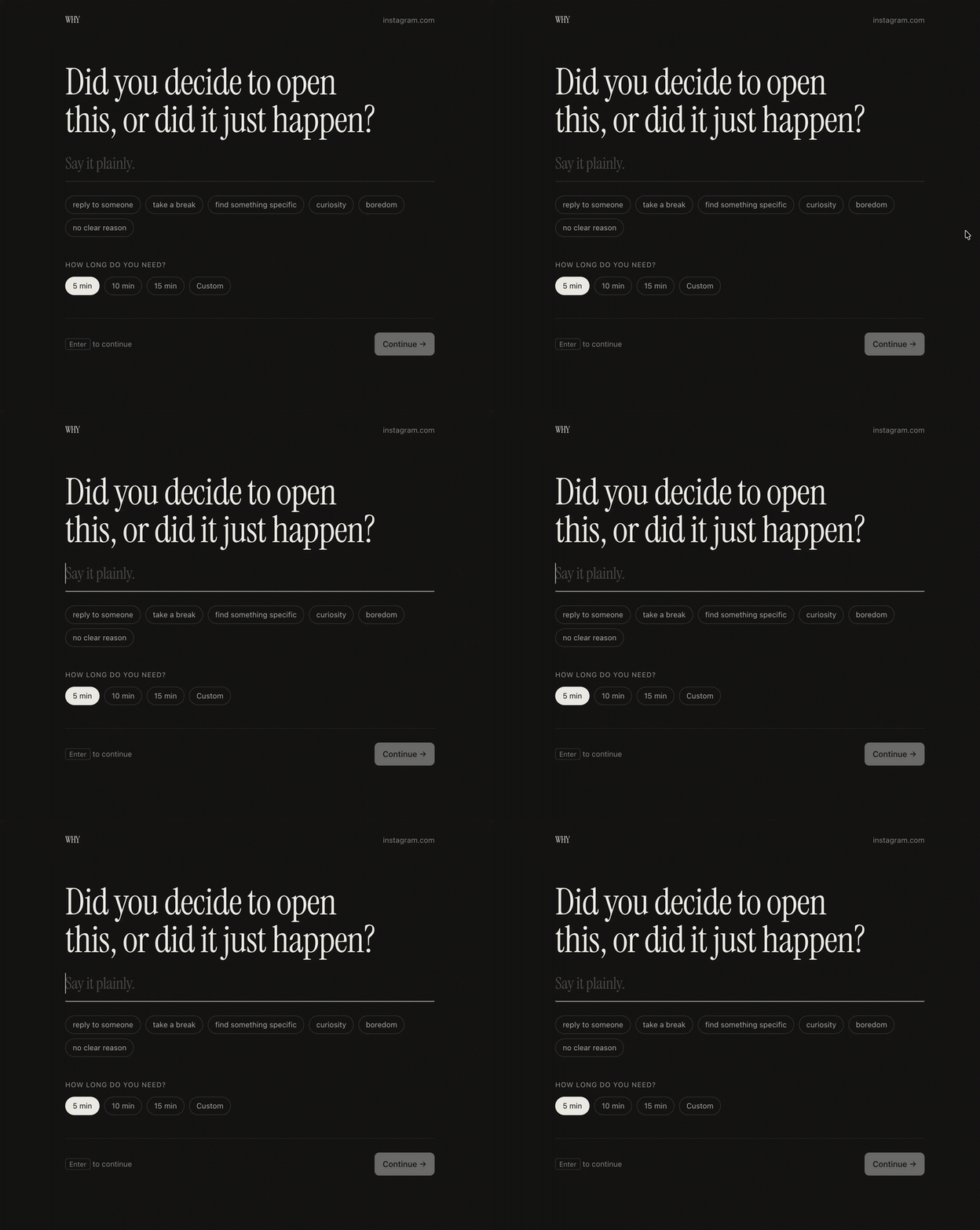
WHY extension asking why you're here before a feed loads
The idea is almost stupidly simple. You pick a handful of sites you know you open on autopilot, the Instagrams, the Reddits, the YouTubes. Open one of them and instead of your feed loading, WHY asks you one question: why are you here, and how long do you want to be here. You answer. A timer starts. When it ends, it asks how it went: done, distracted, or need more time. It's not a blocker. I'm not interested in fighting your willpower, mostly because I've never won that fight against my own. It's not a coach either, it's not going to lecture you. It's closer to a mirror held up right at the exact moment your hand starts moving on its own. It builds a private journal, over time, of why you actually opened these sites, not just how long you stayed. Patterns show up fast once you're forced to answer that question forty times a week instead of zero. Viktor Frankl, of all people, is where the name came from. In Man's Search for Meaning, written out of literal concentration camps, he keeps coming back to one idea that the app is basically a tiny, low-stakes version of.
"He who has a why to live can bear almost any how."
Nobody's Instagram scroll is a concentration camp, I know how that comparison sounds and I'm not making it lightly. But the underlying mechanic scales down fine: a why in hand changes how you experience the how. Open Reddit with a real reason, ten minutes of scrolling for a specific answer, and you'll actually feel done when you find it. Open it with no reason at all, and there is no "done," because there was never a target to hit. You just scroll until something external interrupts you. Frankl's bigger point, the one that matters more than the extension ever will, is this one:
"Everything can be taken from a man but one thing: the last of the human freedoms, to choose one's own attitude in any given set of circumstances, to choose one's own way."
The trigger still fires. The urge still shows up. But the half-second between the urge and the action is still yours, and that half-second is the entire territory this whole post is about. Jonathan Haidt's image from The Happiness Hypothesis is the one that finally made the mechanics click for me. You're not one unified mind deciding things. You're a rider, the conscious, reasoning part, sitting on top of an elephant, the automatic, emotional part that actually supplies the power.
"I can direct things, but only when the elephant doesn't have desires of his own. When the elephant really wants something, I'm no match for him."
The rider thinks it's steering. Most of the time it's confabulating, inventing a tidy explanation after the elephant already decided. "I just wanted to check the time" is the rider's excuse for an elephant that wanted a hit of novelty. Willpower, the thing we keep blaming ourselves for lacking, was never going to be enough on its own. You can't out-reason an elephant. You can only build better paths for it to walk. That's what a well-placed pause actually is: not the rider overpowering the elephant, but a fence placed early enough that the elephant never gets to full speed in the first place. Ask "why am I here" before the feed loads, and you've built the fence at the one point in the loop where it can still hold.
"We are the rider and we are the elephant, and our mental health depends on the two working together, each drawing on the others' strengths."
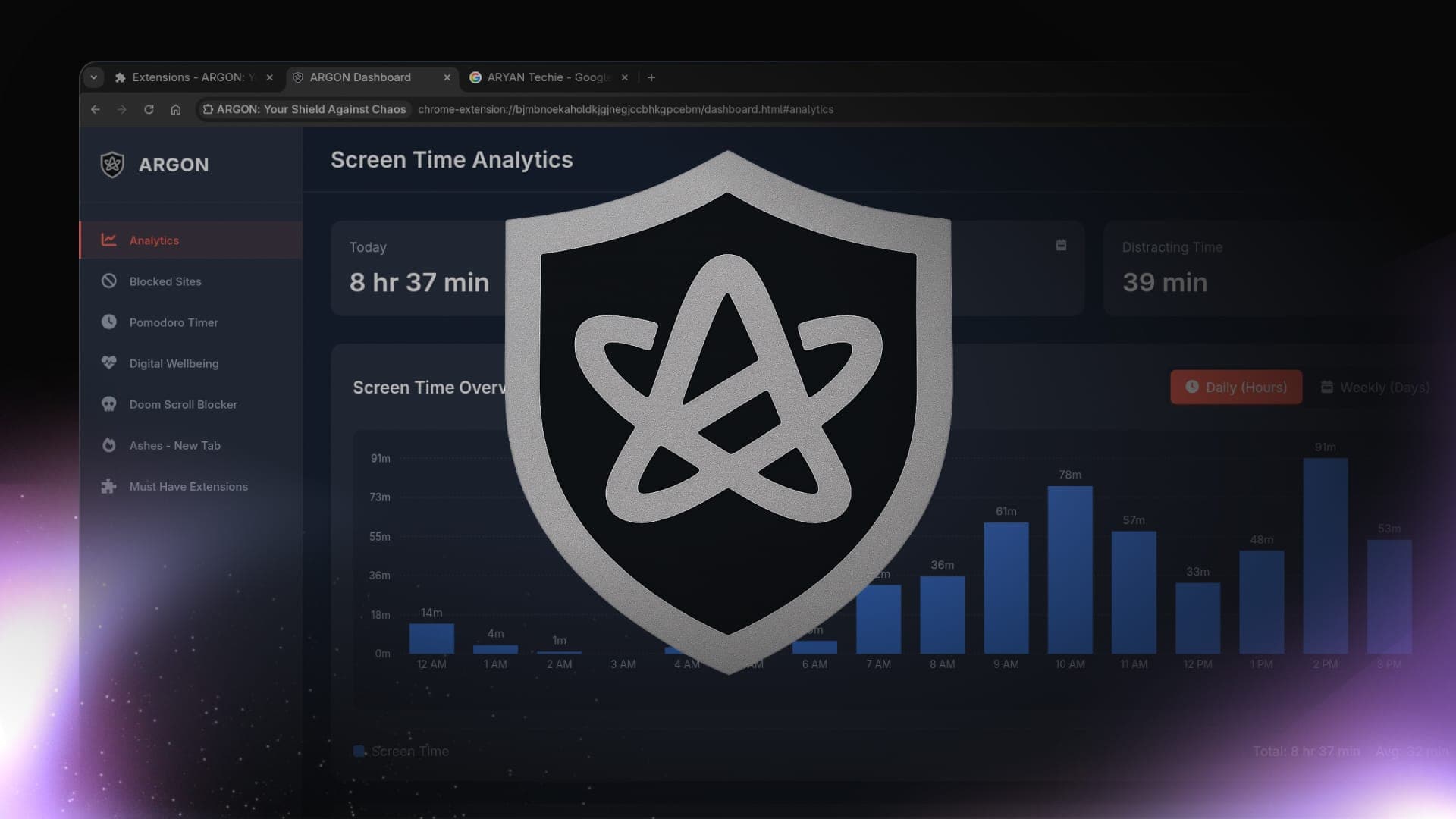
Which loops back to the funnel and the fan. An addicted life is the elephant running the same loop until the rider stops even showing up to argue. A happy life is the two of them actually cooperating, the elephant supplying the drive and the rider pointing it somewhere that keeps expanding instead of collapsing. I'd rather be addicted to building things. Ashes, Monkeybar, Argon, this blog, they're compulsive in their own way too, I chase the feeling of shipping something the same way anyone chases a notification. The difference isn't that I don't have a hook in me. It's that the hook points at something that keeps opening new rooms instead of closing them, one at a time, until there's only one room left. Notice the next time your hand moves before your brain does. You don't need my extension for that part, you just need to actually catch the gap once. Ask yourself, out loud if you have to: why am I here, and how long do I actually want to be here. If you can answer both, you're probably fine. If you can't answer either, that's not a character flaw. That's just an elephant running a groove someone else built for it, on purpose, to be run. Know why you're here. Everything else follows from that.
Share this post:

Subscribe to Aryan’s Newsletter

On The Insight Journal, I share ideas at the intersection of code, clarity, creativity, and systems.