Blog
September 10, 2026•7 min read

The Book That Scared Me Into Turning Off My Lights

Aryan Techie
The Book That Scared Me Into Turning Off My Lights
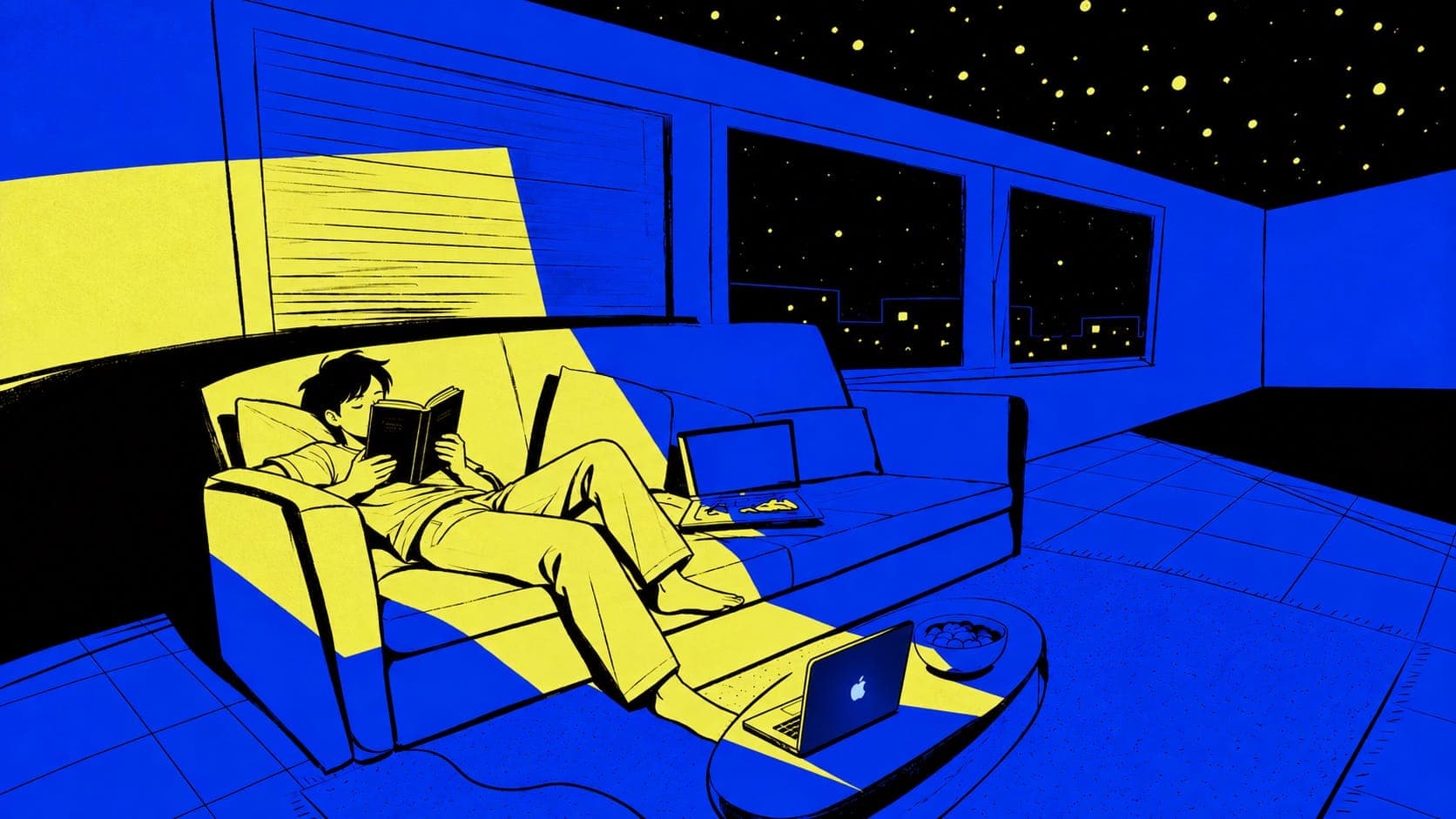
I recently picked up "Why We Sleep" by Matthew Walker. No dramatic reason. I'd seen it quoted everywhere, figured it was time to actually read the thing instead of nodding along when other people mentioned it. So I did what I always do with a new book. I opened it late at night, laptop open next to me, snacks on the table, fully planning to read "just one chapter" before sleeping. Chapter one is not the chapter to read at 1 AM. It's basically Walker sitting you down and listing, calmly and with citations, everything that happens to your body when you don't sleep enough. Cancer risk. Heart disease. Immune system collapse. Alzheimer's. And he doesn't ease into it. It's page after page of "here's what six hours of sleep does to you" while I was sitting there having gotten roughly six hours of sleep on average for the past few weeks. By page forty I was doing the math on my own sleep debt and did not like the answer. I put the book down, turned off every light in the room, and went straight to sleep. Not because I was tired. Because I was scared. A book successfully guilt-tripped me into bed before midnight, and I'm still a little embarrassed about how well it worked. That's the whole tone of the book, though. Not "here's a nice tip," but "here's the data, and it should probably terrify you a little." So it did its job. The first thing that actually reframed how I think about my day: your brain has a shelf life while awake, and it's shorter than you'd guess.
"The recycle rate of a human being is around sixteen hours. After sixteen hours of being awake, the brain begins to fail."
I build things late at night. Ashes, Monkeybar, most of this blog: a lot of it happened after midnight because that's when I felt like the ideas flowed easiest. Walker's answer to that: they weren't flowing easier. I was just too far past my own sixteen-hour mark to notice how much worse the output had gotten. Go without sleep for twenty-two hours, and your judgment and coordination are about as impaired as someone who's legally drunk. Nobody would hand you their car keys in that state. Most of us hand ourselves a keyboard and a work deadline instead. What stuck with me:
  • There's no such thing as "catching up" on sleep debt. The deficit compounds, it doesn't reset
  • Ten days of seven hours of sleep leaves your brain as dysfunctional as one full night with zero sleep
  • Feeling "used to" being tired isn't adaptation. It's just your baseline for normal quietly dropping
I used to think of sleep as the thing that happens when nothing else is happening. The pause button. Walker spends the entire book dismantling that idea.
"There is no major organ within the body, or process within the brain, that isn't optimally enhanced by sleep, or demonstrably impaired when we don't get enough."
The part that got me: after just one night of bad sleep, the natural killer cells your immune system uses to fight off cancer cells drop by around 70%. Not over a bad month. One night. Your body is doing real, measurable maintenance work while you're unconscious, and skipping it isn't neutral. It's actively undoing repairs. Same story with the heart. Walker points to what happens every year when daylight saving time takes an hour of sleep away in spring: heart attacks spike the very next day. In autumn, when we get an hour back, they drop. One hour. That's how sensitive the system actually is. Why this actually matters, in plain terms:
  • Sleep isn't the brain switching off. It's the body running scheduled maintenance
  • Skipping sleep doesn't just cost you energy, it costs you repair time you don't get back
  • "I'll sleep when I'm dead" is, unfortunately, closer to a prediction than a joke
This is the idea I keep coming back to, because it directly contradicts how I was taught to think about getting better at anything.
"Practice does not make perfect. It is practice, followed by a night of sleep, that leads to perfection."
Walker's research shows your brain keeps working on what you learned that day while you sleep, replaying it, filing it, strengthening the connections. Skip the sleep, and you basically skip the part where the learning becomes permanent. You did the work and then threw away the step that made it count. I've pulled all-nighters before a launch thinking I was buying myself more building time. Turns out I was probably just building worse, slower, and forgetting more of it a week later. The all-nighter wasn't extra time. It was borrowed time, with interest. The part of the book I wasn't expecting to care about was the chapter on dreaming. I went in thinking REM sleep was mostly a curiosity. Walker treats it as one of the most important things your brain does all day.
"There is no major psychiatric condition in which sleep is normal. This is true of depression, anxiety, PTSD, schizophrenia, and bipolar disorder."
His argument is that REM sleep works like overnight therapy. It lets your brain revisit the day's emotionally charged moments and strip out the sharp edge, so you remember the event without still feeling the full sting of it. Lose enough REM sleep, and that stripping-out process stops happening. You wake up carrying yesterday's anxiety at full volume, with nothing to dull it. That reframed a lot of my worse days for me. The mornings where everything feels like too much usually trace back to a night where I didn't actually get much sleep, not to the day itself being uniquely bad. I'm not going to pretend I've fixed my sleep because of one book. I still open my laptop at hours I shouldn't. But I notice it now, and noticing is most of the battle. If you're the kind of person who wears "I only need five hours" as a badge of honor, that's the one claim in this entire book Walker has zero patience for. He'll tell you, bluntly, that you're not one of the rare genetic outliers who can actually function on that. Almost nobody is. Simple steps, if you want to steal them from me:
  • Don't start a new book chapter, or a new work session, within an hour of when you meant to sleep
  • Treat "I'll catch up this weekend" as the myth it is; the debt doesn't fully clear
  • If you notice yourself getting scared reading about sleep science at 1 AM, that's your body telling you something. Listen to it.

Turn the lights off. Not because a book guilt-tripped you into it, though fair warning, this one might. Do it because the version of you that shows up tomorrow is quite literally built overnight.
Share this post:

Subscribe to Aryan’s Newsletter

On The Insight Journal, I share ideas at the intersection of code, clarity, creativity, and systems.